An in-depth look at fuel storage terminal design, tank types, automation, loading gantries, quality control, strategic reserves and safety standards.
Why Fuel Storage Terminals Are the Hidden Backbone of Energy Supply
Fuel storage terminals rarely feature in public conversations about energy, yet they are the single point in the supply chain where crude oil, refined products and biofuels are held, blended, quality-checked and staged before reaching filling stations, industrial consumers, airports and power stations. A country's ability to keep vehicles moving, factories running and hospitals powered during a supply disruption depends less on any single refinery or pipeline than on the buffering capacity sitting quietly in its tank farms. For a landlocked country such as Botswana, which imports the overwhelming majority of its refined petroleum products by road and rail from coastal terminals in South Africa, Namibia and Mozambique, terminal infrastructure and strategic storage capacity are not a logistics afterthought — they are a matter of genuine national energy security. Big Oil Trading Company Limited (BOTC), headquartered in Gaborone, treats oil trading, bunkering and storage terminals as one of its five core strategic business units, recognising that reliable storage infrastructure underpins every other part of an integrated oil energy business. This guide sets out, in practical detail, how fuel storage terminals are designed, operated and secured, and why this infrastructure matters so much to Botswana and the wider region.
A modern fuel terminal is far more than a collection of large tanks. It is an integrated system combining tank design engineering, automated inventory and blending control, safety and environmental protection systems, and a logistics interface — rail sidings, pipeline connections or road loading gantries — that moves product efficiently in and out without compromising quality or safety. Understanding how these pieces fit together helps explain why terminal capacity, not just refining capacity, is so often the true constraint on a country's fuel supply resilience.
Tank Types: Fixed Roof, Floating Roof and Bunded Design
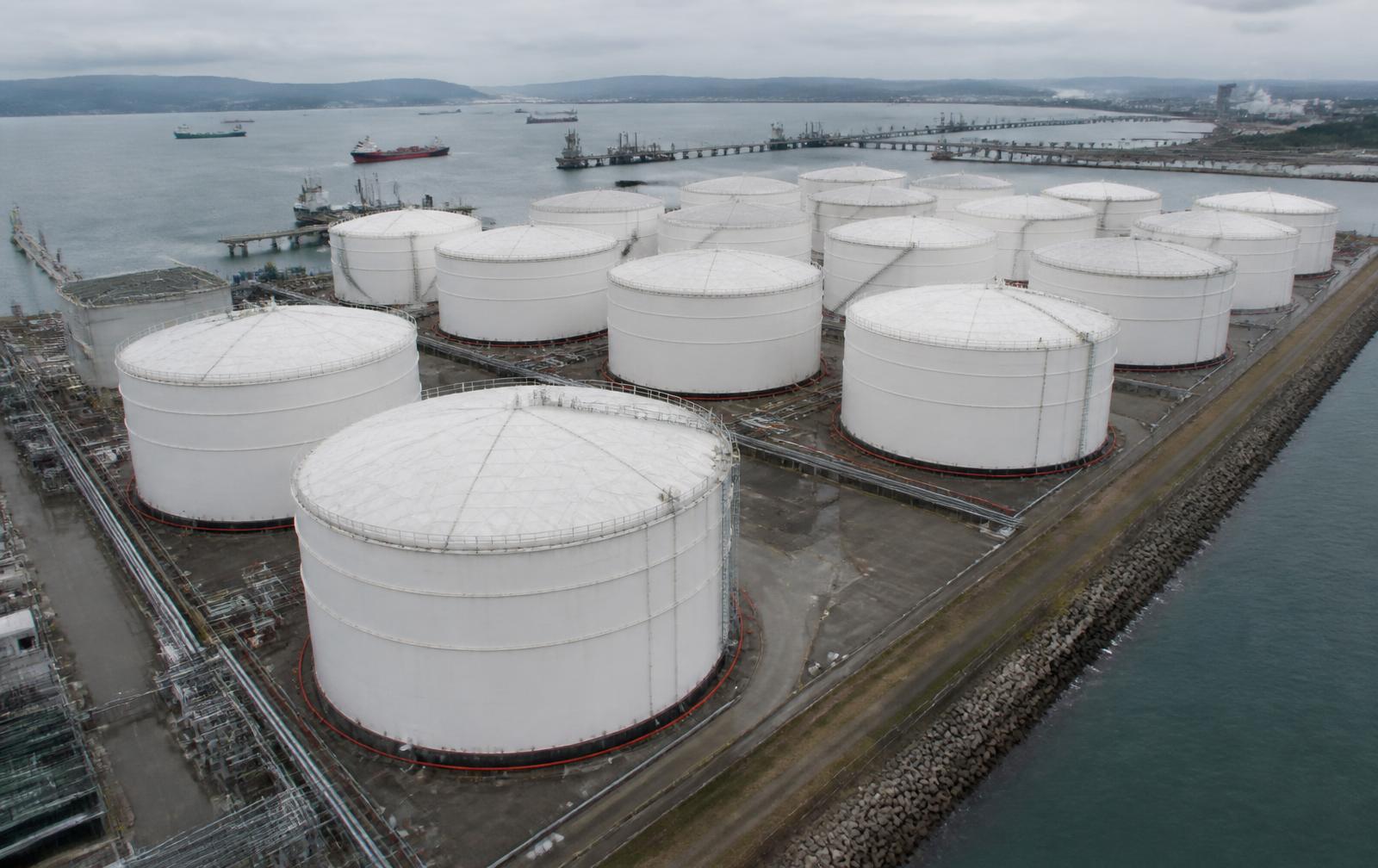
The choice of tank design at a terminal is driven primarily by the volatility of the product being stored, the throughput required, and the environmental and safety standards the facility must meet.
- Fixed roof tanks, the simplest and most economical design, are typically used for less volatile products such as diesel, gas oil, bitumen and lubricating base oils, where evaporative loss and vapour space hazards are comparatively limited
- External floating roof tanks feature a roof that rests directly on the surface of the stored liquid and rises and falls with tank level, dramatically reducing the vapour space above volatile products such as petrol (mogas) and crude oil, and correspondingly reducing evaporative losses and fire risk
- Internal floating roof tanks combine a fixed outer roof with an internal floating pan, offering the evaporative loss control benefits of a floating roof while also protecting the product and roof mechanism from rainfall, dust and direct weathering, an arrangement well suited to Botswana's dusty, high-temperature climate
- Bunded (or diked) tank installations surround each tank, or group of tanks, with a containment wall sized to hold the full volume of the largest tank within the bund plus an allowance for rainfall, ensuring that a catastrophic tank failure or major leak cannot spread product beyond a contained area
- Horizontal cylindrical tanks and smaller above-ground or below-ground vessels remain common at smaller distribution terminals, filling stations and industrial sites where full-scale vertical tank farms are not justified by throughput volumes
Tank sizing and configuration decisions also reflect blending and product segregation needs: a terminal handling multiple grades of diesel, several octane grades of petrol, jet fuel, and biofuel blending components needs enough distinct, properly segregated tankage to avoid cross-contamination, which is itself one of the more expensive and reputationally damaging failures a terminal operator can experience.
A tank farm's true capacity is not just the sum of its tank volumes — it is that volume constrained by how well the facility can keep every grade of product pure, every bund watertight, and every valve correctly aligned under pressure.
Terminal Automation and Inventory Control
Modern fuel terminals increasingly rely on automated tank gauging, inventory management and process control systems to replace what was once manual dipstick measurement and paper-based stock reconciliation.
- Automatic tank gauging (ATG) systems use radar, servo or hydrostatic level sensors to provide continuous, accurate real-time measurement of product volume, temperature and, in some installations, water bottom levels in every tank
- Supervisory control and data acquisition (SCADA) platforms integrate tank gauging, pump and valve control, and flow metering into a single operational picture, allowing terminal staff to monitor and control receipt, transfer and dispatch operations from a centralised control room
- Automated stock reconciliation, comparing metered receipts and deliveries against tank gauge movements, helps terminals detect losses, leaks or metering discrepancies quickly rather than discovering shortfalls only at month-end stocktake
- Overfill prevention systems, independent of the primary level gauging, provide a critical safety backstop by automatically halting inbound transfers if a tank approaches its maximum safe fill level, a safeguard that has been mandated more widely across the industry following several serious historical overfill incidents worldwide
- Integration with enterprise resource planning and terminal management software allows automated generation of delivery documentation, customer invoicing data and regulatory reporting, reducing administrative burden and improving traceability
Investment in terminal automation delivers returns well beyond convenience: it reduces product loss through more accurate measurement, shortens the time needed to receive and dispatch large product volumes, and provides the data trail regulators and auditors increasingly expect from modern fuel storage operations.
Loading Gantries and Product Dispatch
The loading gantry is where stored product is transferred into road tankers, rail wagons or, at larger coastal facilities, marine vessels, and it is one of the busiest and most safety-critical areas of any terminal.
- Bottom-loading gantries, now the industry standard for road tanker loading, fill tankers from the bottom through a sealed connection rather than from an open top hatch, dramatically reducing vapour release, splash-related static risk and operator exposure compared to older top-loading arrangements
- Metered loading arms with batch controllers allow precise, pre-set volumes to be dispatched automatically, improving both loading speed and delivery accuracy
- Overfill protection and grounding (earthing) verification systems on each loading bay prevent static discharge ignition risk and stop loading automatically if a tanker is not correctly earthed or if fill level limits are reached
- Additive injection systems at the gantry allow specific dyes, lubricity improvers or other additives to be blended into the product stream at the point of loading, supporting product differentiation and fiscal marking requirements without the need for separate tankage for every additive combination
- Vehicle access control and queuing management, increasingly automated through card or biometric systems linked to the terminal's inventory platform, improve both security and turnaround time during high-demand periods
For a country like Botswana, where the great majority of finished product ultimately moves onward from terminal to filling station or industrial customer by road tanker, gantry throughput capacity and reliability directly determine how quickly a supply disruption at the terminal level cascades into pump-level shortages, making gantry design and maintenance a genuinely strategic concern rather than a purely operational one.
Product Quality Control and Tank Cleaning
Maintaining product quality throughout the storage and dispatch process is one of a terminal's most important responsibilities, since a contaminated or off-specification delivery can damage engines, void warranties and create serious reputational and legal exposure.
- Routine sampling and laboratory testing at receipt, during storage and prior to dispatch verify that product remains within specification for density, water content, sulphur content, octane or cetane rating and other relevant parameters
- Water bottom monitoring and periodic draining prevent water accumulation at the base of tanks, which can otherwise support microbial growth (particularly in diesel and biodiesel blends) and lead to filter blocking and injector damage in end-use equipment
- Tank cleaning programmes, carried out on a scheduled basis or when switching a tank between product grades, remove accumulated sludge, scale and sediment that can otherwise contaminate subsequent deliveries and reduce effective tank capacity over time
- Filtration and water separation equipment installed in the delivery line, particularly for aviation fuel and increasingly for diesel given growing biodiesel content, provides a final quality safeguard immediately before product leaves the terminal
- Certificate of quality and certificate of quantity documentation, issued for every batch received and dispatched, gives customers and regulators a clear audit trail confirming that product met specification throughout its time at the terminal
Quality control discipline is especially critical at terminals handling multiple product grades through shared infrastructure, where the risk of accidental cross-contamination during valve line-up changes is ever-present and where the cost of a single contaminated batch reaching customers can far exceed the cost of the quality assurance programme that would have prevented it.
Strategic Fuel Reserves and Energy Security for Landlocked Countries
For coastal nations with direct access to refineries and import terminals, a supply disruption can often be resolved within days. For landlocked countries such as Botswana, Zambia, Zimbabwe, Malawi and Lesotho, fuel must travel hundreds of kilometres from a coastal or refinery source, and any disruption — whether a port closure, a refinery outage, a border delay or a transport strike — can take considerably longer to resolve, making buffer storage capacity a genuine strategic asset rather than simply an operational convenience.
- National strategic fuel reserves, typically held in dedicated government or government-mandated storage facilities, are designed to cover a defined number of days of national consumption, giving authorities time to manage a supply disruption without immediate rationing or shortage at the pump
- Commercial terminal storage held by trading and distribution companies adds a further layer of buffer capacity beyond the formal strategic reserve, smoothing out the day-to-day and week-to-week variability in supply chain timing
- Diversifying import routes and terminal locations, rather than relying on a single corridor or single coastal terminal, reduces the risk that any one point of failure can disrupt the entire national supply chain
- Regular reserve stock rotation is essential, since stored fuel can degrade in quality over extended storage periods, particularly diesel susceptible to microbial contamination and biofuel blends with more limited shelf stability than pure mineral fuel
- Regional cooperation agreements among landlocked SADC states and their coastal neighbours, covering transit arrangements, border clearance procedures and emergency supply protocols, further strengthen collective energy security across the region
For a landlocked economy, tank capacity is measured not just in litres but in days of resilience — the gap between a supply disruption starting and the moment it is actually felt at the pump.
The economics of holding strategic reserves are not trivial — tied-up capital, storage costs and stock rotation losses all represent a real cost — but they are consistently judged by governments and major fuel distributors across the region to be a worthwhile investment against the far larger economic cost of transport, agricultural and industrial disruption that follows even a short, unmanaged fuel shortage.
Throughput Agreements and Tank Leasing
Not every company that needs fuel storage capacity owns or operates its own terminal, and a well-developed secondary market in terminal capacity has grown up around throughput agreements and tank leasing arrangements.
- Throughput agreements allow a fuel trading or distribution company to contract for the right to move an agreed volume of product through a third-party terminal's tankage and gantry infrastructure over a defined period, without owning the physical tanks
- Dedicated tank leasing arrangements give a customer exclusive use of specific tanks for an agreed term, useful for companies needing guaranteed segregated storage for a particular product grade or blending requirement
- Common-user terminal models, where multiple companies share access to pooled tankage under coordinated scheduling, improve overall asset utilisation across a market but require reliable scheduling, metering and product segregation discipline to avoid disputes
- Terminal capacity contracts increasingly include service-level commitments covering loading turnaround times, minimum tank availability and quality assurance standards, reflecting the growing sophistication of commercial terminal access arrangements
- For smaller trading companies and new market entrants, throughput and leasing arrangements provide a practical route to market access without the very substantial capital investment required to build dedicated terminal infrastructure from scratch
This secondary capacity market plays an important role in overall market efficiency, allowing storage infrastructure to be used more fully across multiple market participants rather than each company needing to build and maintain its own underutilised tank farm.
Vapour Recovery and Environmental Controls
Environmental performance has become an increasingly central consideration in terminal design and operation, driven both by regulatory requirements and by the direct economic value of the product being conserved.
- Vapour recovery units (VRUs) capture hydrocarbon vapours displaced during tank filling and tanker loading, condensing or absorbing them for return to the product stream rather than releasing them to atmosphere, reducing both product loss and air quality impact
- Floating roof tanks, as discussed earlier, are themselves an important vapour loss control measure for volatile products, minimising the vapour space in which evaporation can occur
- Secondary containment (bunding), impermeable tank pad linings and leak detection systems protect groundwater and soil from contamination in the event of a tank or pipework failure
- Stormwater management systems, including oil-water separators on bund drainage, ensure that rainfall collected within containment areas can be safely released without carrying hydrocarbon contamination into the surrounding environment
- Regular environmental monitoring, including groundwater monitoring wells at many larger terminals, provides early warning of any contamination that might otherwise go undetected for years
Terminal operators who invest proactively in vapour recovery and environmental control systems typically find that the product volume recovered, combined with reduced regulatory and remediation risk, delivers a return that comfortably justifies the investment well beyond the pure compliance argument.
Terminal Safety Standards
Fuel storage terminals handle large volumes of flammable and, in some cases, toxic materials, and safety management is consequently one of the most heavily engineered and tightly regulated aspects of terminal operation.
- Fire detection and suppression systems, including foam deluge systems for tank fires and fixed or semi-fixed foam monitors covering loading gantries, are designed and tested against recognised international standards such as those published by the National Fire Protection Association (NFPA)
- Static electricity control measures, including bonding and earthing at every loading connection, are essential given that petroleum vapours can be ignited by even very small static discharges during tanker filling
- Process hazard analysis and management-of-change procedures ensure that any modification to tank configuration, piping or operating procedure is properly assessed for safety impact before implementation
- Permit-to-work systems govern hot work, confined space entry and tank cleaning operations, all of which carry elevated risk and require specific controls, atmospheric testing and supervision
- Emergency response planning, including mutual aid arrangements with neighbouring facilities and local fire services, and regular emergency drills, ensures that terminal staff and surrounding communities are protected in the event of a serious incident
- Independent safety audits and adherence to international standards and codes of practice give both regulators and customers confidence that a terminal is operated to a consistently high standard rather than merely meeting the minimum legal requirement
These safety systems are not simply regulatory box-ticking; large-scale terminal fires and explosions in various parts of the world over past decades have demonstrated, at great human and economic cost, exactly what is at stake when safety management systems are allowed to weaken, and the industry's current standards reflect hard-won lessons from those events.
Terminal Site Selection and Layout Considerations
The physical location and layout of a terminal has long-term implications for its operating efficiency, safety and expansion potential, and deserves the same rigorous planning applied to any major piece of national infrastructure.
- Proximity to key transport corridors, whether rail lines, major highways or, for coastal terminals, deep-water berths, directly determines ongoing logistics cost and delivery speed to end markets
- Buffer distances from residential areas, schools and other sensitive land uses are typically mandated by land-use planning and safety regulations, reflecting the consequence-based risk profile of fuel storage
- Site topography and drainage design influence both bund containment performance and stormwater management, particularly important in areas subject to intense seasonal rainfall
- Future expansion allowance, reserving adjacent land and designing initial infrastructure (such as pipeline racks and access roads) with future capacity growth in mind, avoids costly retrofitting as demand grows over a terminal's multi-decade operating life
- Utility access, including reliable electricity supply for pumps and automation systems and adequate water supply for firefighting systems, is a frequently underestimated but essential site selection criterion
Getting terminal siting and layout right at the outset avoids many of the constraints that otherwise limit a facility's ability to grow with demand or adapt to new product types over its operating lifetime.
Big Oil Trading Company's Role in Storage Infrastructure
Big Oil Trading Company Limited has established oil trading, bunkering and storage terminals as one of its five strategic business units, placing terminal infrastructure at the centre of its integrated business model alongside crude oil refinery and recycling, bitumen manufacturing, shipping and logistics, and boutique filling stations. This integrated structure reflects a clear recognition that reliable storage capacity is the foundation on which consistent fuel, lubricant and bitumen supply is built, particularly for a landlocked market such as Botswana where the distance between coastal source and inland consumer makes buffer capacity strategically important rather than merely convenient.
For government agencies, industrial fuel consumers, fleet operators and fellow traders across Botswana and the wider SADC region, the practical significance of this guide is straightforward: terminal infrastructure quality — tank design, automation, quality control discipline, environmental protection and safety management — has a direct bearing on the reliability, purity and safety of every litre of fuel or lubricant that eventually reaches an end user. A storage and trading partner that understands and invests in these fundamentals, as part of a wider integrated oil energy business spanning trading, refining, shipping and retail, is far better positioned to support the region's long-term energy security than a purely transactional supplier of product alone.
- Storage terminals are one of BOTC's five core strategic business units
- Integrated trading, refining, bitumen manufacturing, shipping and retail capability supports resilient regional fuel supply
- Terminal infrastructure quality directly determines product integrity and supply reliability for landlocked markets
- BOTC's Gaborone base positions it centrally within Botswana's inland fuel supply and storage network
In a landlocked economy, the tank farm is the nation's shock absorber — every litre held in reserve is a day of resilience against the next disruption on the long road from the coast.